 HOME
HOME
 Teletherm Infrared
 Systems/Research
________________________________________
25 years of providing clinical IR systems
Green technology for health imaging!
|
Images courtesy of Teletherm Infrared Systems/Research ________________________________________ 25 years of providing clinical IR systems Green technology for health imaging! |
| CONTACT US THERMAL IMAGERS TRAINING CLINICAL STUDIES VETERINARY SOFTWARE ACCESSORIES HISTORY ERGONOMICS INDUSTRIAL |
|
Infrared Thermal Evaluations Provide a
responsive ergonomics Establish Assess workers Non-invasive Objective A preventive Efficient
|
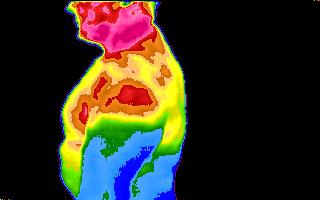
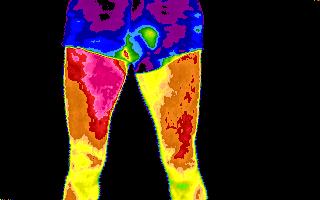
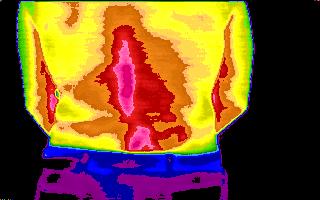
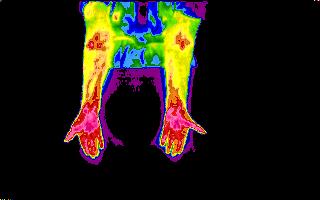
Ergonomics - Worker Evaluations 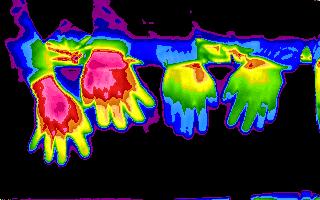 Adult male hands/those on right are cooler
Simple non-invasive infrared scans provide pictures similar to the following images:
BMJ 1997;314:118 (11 January) Thermographic
changes
in keyboard operators S D Sharma, Research Fellow, E M Smith, Research Nurse, B L Hazleman, Consultant Rheumatologist,J R Jenner, Consultant Rheumatologist Rheumatology
Research Unit,
Box 194, Cambridge CB2 2QQ, b Addenbrookes NHS Trust, Cambridge CB2
2QQ Chronic incapacitating forearm pain and disability in the context of repetitive action has caused much debate. Lack of objective measurements in a condition with diverse symptoms, few physical signs, and uncertain pathology is a major problem. Clinical observations have suggested the presence of vasomotor changes in repetitive strain injury, so we used computer assisted thermography to assess this. We conclude that
thermography
needs further evaluation as a diagnostic tool in evaluating repetitive
strain injury. It may prove more useful in follow up, particularly in
measuring
response to treatment, some of which has been prescribed at enormous
cost
and with little evidence of benefit. J Hand Surg [Am] 1987 Sep;12(5 Pt 2):943-9 Thermography
in the detection
of carpal tunnel Herrick RT,
Herrick SK Studies were
conducted using
liquid crystal thermography (FlexiTherm) and electronic thermography
for
the diagnosis of carpal tunnel syndrome. Studies were also conducted to
differentiate carpal tunnel syndrome from peripheral neurovascular
injuries.
Ninety patients were included in the study, with an average follow-up
time
of 24 months. Fifty patients also had electric studies for comparison
and
contrast. Thermal patterns of carpal tunnel syndrome showed a
decreased
vascular heat emission pattern over the median nerve distribution.
The procedures using thermography consisted of imaging of the cervical
spine, shoulders, forearms, and hands. Results of the studies showed
that
thermographic studies were efficacious and sensitive for the
differential
diagnosis of carpal tunnel syndrome from other peripheral compressive
neuropathies,
including cervical radiculitis, thoracic outlet syndrome, cubital
tunnel
syndrome, and Guyon's canal syndrome. Biomechanic and etiologic factors
indict carpal tunnel syndrome to be an occupational disease. Thermographic
technique use may lead to the early diagnosis, treatment, and
preventative
measures that could eliminate the high cost of manpower loss and of
medical
care often J Hand Surg [Am] 1992 Jul;17(4):631-7 Thermographic
observations
in unilateral carpal tunnel Tchou S,
Costich JF, Burgess
RC, Wexler CE This study was
undertaken
to assess the sensitivity and specificity of thermographic diagnosis of
unilateral carpal tunnel syndrome in a patient population large enough
to permit meaningful statistical analysis. Sixty-one persons with
clinical
diagnoses of unilateral carpal tunnel syndrome confirmed by
electrodiagnostic
examination and 40 symptom-free volunteers underwent standard
thermographic
examinations. The thermographic images were then randomly sorted and
interpreted
by an experienced physician thermographer. Fifty-seven of the 61
patients
with carpal tunnel syndrome were found to have thermographic
abnormalities,
while only one of the control group was found to have such an
abnormality.
Individual area sensitivity was highest in the dorsal area, but
addition
of other regions increased this measure; specificity ranged between 98%
and 100%. These findings would appear to confirm the value of
thermography
in the diagnosis of unilateral carpal tunnel syndrome.
Med Tr Prom Ekol 1995;(9):37-9 [Thermographic
signs of
forearm myopathies in industrial [Article in
Russian] The authors
described thermographic
sign of forearm myopathy similar to RSI in industrial workers. The
sign
is that upper third of the forearm has skin temperature higher by over
0.3 degree C (for associated cervical osteochondrosis--by over 0.5
degree C) as lower third of the forearm. The temperature gradient (up
to
2.5 degrees C) appeared to correlate with more marked myopathy.
Zh Nevropatol Psikhiatr Im S S Korsakova 1991;91(10):17-20 [Automated diagnosis of vibration disease]. [Article in
Russian] Based on a
multidimensional
discriminant analysis of the clinical and physiological characteristics
derived as a result of examination of 593 miners, classification
functions
were plotted, allowing the diagnosis of vibratory disease in the
automatic
mode by means of mathematic computations. Functional indicators of skin
sensitivity, particularly vibratory, dynamometry, rheovasography and thermography
of the hand and fingers, a "white spot" symptom, and
characteristics
derived on a Med Pr 1985;36(3):173-8 [Usefulness of
thermal
tests for evaluating vascular changes Tutak T The
investigations have been
carried out on 40 workers of an industrial factory. Twenty workers used
vibration tools, the others, having no contact with vibration,
constituted
the control group. Each subject had his skin temperature measured at 19
points of the left and right hands at ambient temperature of 22 degrees
C and after cooling at 15 degrees C and 8 degrees C. The results
have
demonstrated that early vasomotor changes are best identified by the
thermal
test with cooling at 8 degrees C. Furthermore, this method enables
a topographic estimation of the hand areas for special risk of the
disturbances
in blood vessels of workers using vibration tools. Skeletal Radiol 1984;12(4):235-49 Normal
thermographic standards
for the cervical spine Feldman F, Nickoloff EL Although
thermography has
been used for a variety of abnormal conditions, extensive data on
large,
relatively asymptomatic populations has heretofore not been available.
More specifically, no data deal with the upper extremities and, more
particularly,
no analyses are based on simultaneous thermograms of the posterior neck
and shoulders. The current study undertook this task. The results
confirm
the existence of thermal symmetry in the overwhelming majority of 100
normal
relatively asymptomatic, actively employed factory workers. Conversely,if
persistent, statistically significant thermal asymmetry exists, as
outlined
and correlates with patient symptomatology, an organic basis for it
should
be sought. Vrach Delo 1989 Aug;(8):108-10 [Thermography
in the diagnosis
of respiratory organ Shelygin SI A thermographic study of the chest was of importance in the diagnosis and differential diagnosis of pneumoconiosis, chronic dust-induced bronchitis, unspecific pulmonary diseases. This could substitute traditional methods of examination. Results make it possible to recommend the method of thermography in the diagnosis of professional diseases as well as in periodic prophylactic screenings of coal miners. |