|
|
| Veterinary
Applications with Teletherm Large and Small Animals
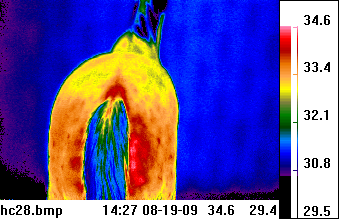
Equine Veterinary Journal 2009 Jan; 41(1):18-23 - Department of Large Animal Surgery and Anaesthesiology, Ghent University, Belgium "Thermography is a valuable and rapid clinical tool to monitor the development of cast sores." J. Dairy Sci 2008 Dec; 91(12):4592-8 "A thermal camera mounted in a milking or feeding parlor could detect temperature changes associated with clinical mastitis or other diseases in a dairy herd." "... changes in circulation may be noted even before lesions can be confirmed with ultrasound." Clark Equine Clinic, Albion, Idaho "It can be concluded that surface temperature changes assessed using infrared thermography, in particular of the hen's comb, are sensitive to husbandry procedures such as handling and represent a potentially useful method for assessing stress-induced hyperthermia in chickens." School of Veterinary Sciences, University of Bristol, Langford UK. |
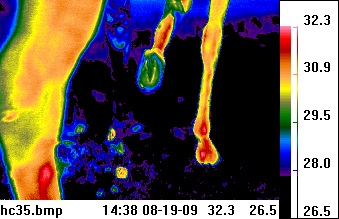
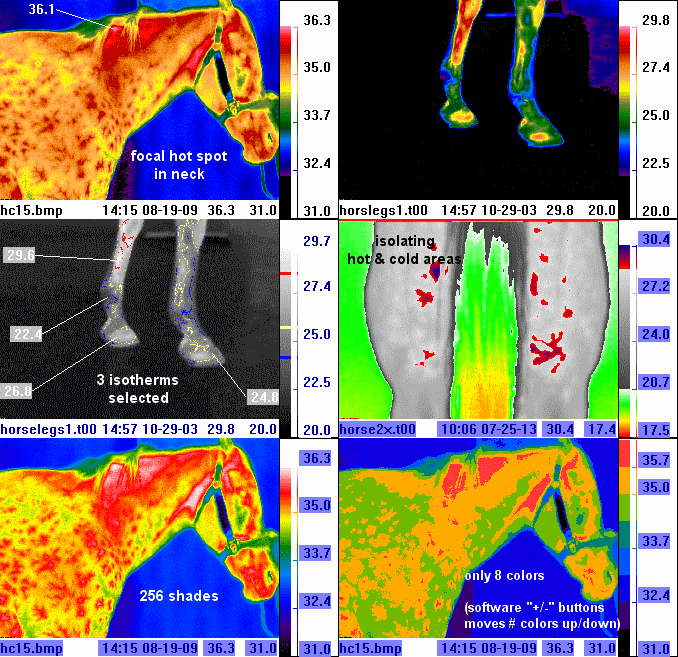 Note detail on the horse image and the various areas of hot and cold associated with the animal's head, neck, leg, hind regions. Online Veterinary Infrared Training Program The images on this page are just a few examples of various animal subjects. They have been taken with the Teletherm infrared imaging system which operates in the optimum 8-12 micron range of the infrared spectrum. It is also a radiometric device which means it shows the temperature values at any location on the image. 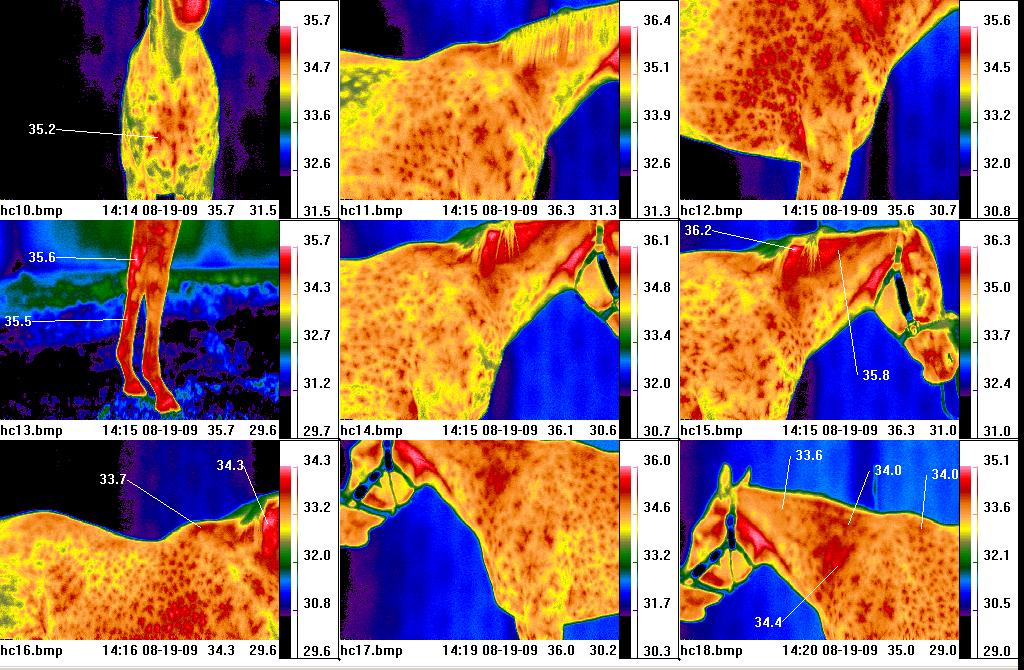 |
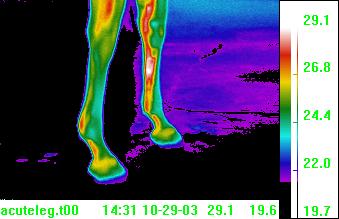 Evaluate the suspensory ligament. 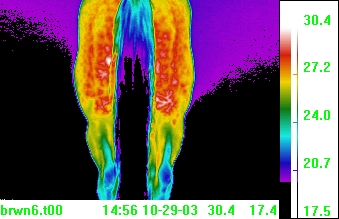 Evaluate muscle tears. Taking pictures with an infrared camera to evaluate a painful condition on a horse is quite dramatic and extremely helpful to the veterinary physician or horse trainer. |
There has been greater utilization with large animals in the private clinical setting than with small ones. Laboratory animals such as rats, rabbits, or monkeys have been used to understand certain disease processes or the effects of pharmaceutical products and therapies. An objective thermal perspective is provided. Other Available Thermal Imaging Courses 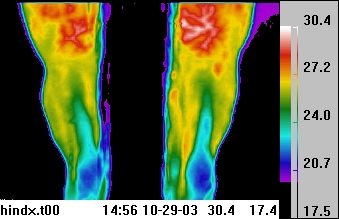 Digital zoom showing muscle tear on right hind.
|
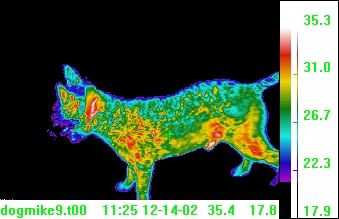 Thermal image of small dog. 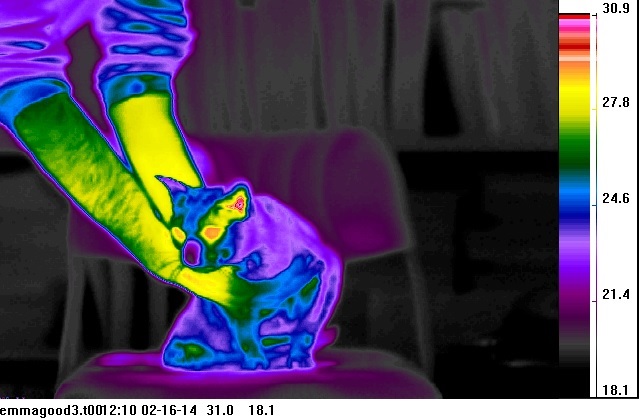 Thermogram of a Siamese cat |
Zoo animals can also be helped by making sure there are no soft tissue injuries, that otherwise might go undetected. Thermal
imaging is an objective assessment of the
situation where communication between animal
and doctor may be limited, or not properly
understood through other methods.
|
| LEARN
MORE. Receive
updated material on infrared thermal
imaging. Please complete the form below: Email
address: teletherm@thermology.com |
(C) Copyright 1999-2015 Teletherm Infrared Systems / Research, Asheville, NC - Tampa, FL. USA Telephone: 813/418-6165 or email: teletherm@thermology.com All rights are reserved worldwide.
(C)
Copyright 2005-2015 Teletherm color palette
designation EYESC3, EYECLOSE1, Teletherm
Infrared Systems / Research - Asheville, NC -
Tampa, FL. USA. All rights are
reserved worldwide.